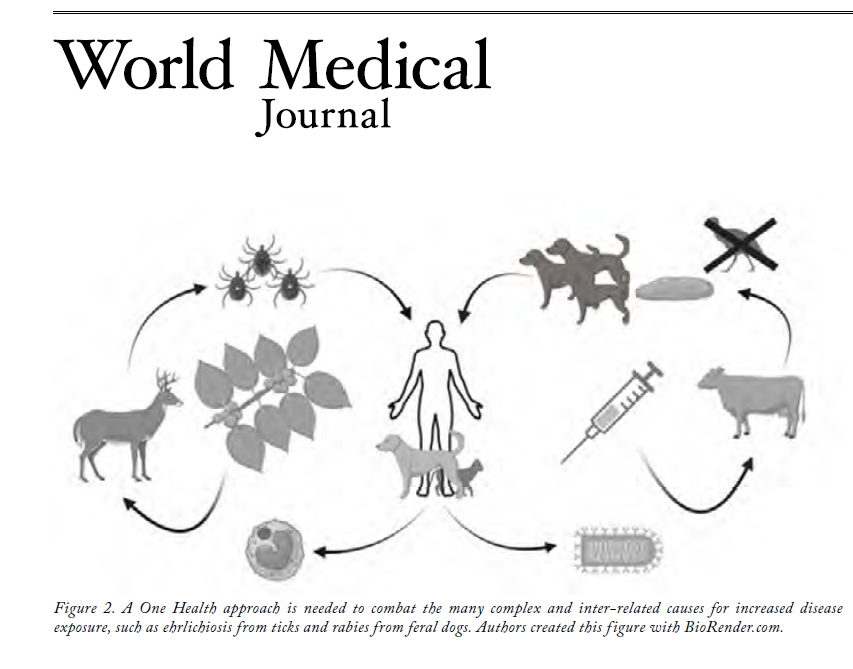
As the interconnections between the health of humans and other animals increases in the current Anthropocene epoch, a conservation medicine approach becomes all the more critical for wildlife and wild land conservation and public health.
One Health. One Home.
Meet Dr. Sharon Deem
Dr. Sharon Deem speaks regularly and attends events based around conservation and wildlife frequently. She is available for speaking engagements, press, or general questions.
Living the life of an international veterinarian is not always glamorous, but it sure is interesting. Follow along to see Dr. Deem's adventures on her quest for conservation.
Field Journal
Conservation news and notes from around the globe.
January 2020 was designated as National One Health Awareness Month by a bipartisan resolution that recognizes the importance of a collaborative, interdisciplinary—One Health—approach so we might find solutions to the public health, environmental, and conservation challenges of the 21st century. In this blog, I have put my 31 daily social media posts for this month. It is my hope that in one long chain, we see the common threats, many taken straight out of current affairs, from climate change and mental health issues to pandemics preparedness and prevention. And, more importantly we see some of the amazing work being done globally to strive for healthy people, healthy animals, and healthy environments. I hope you enjoy learning about One Health.
Are camels the new cow of Kenya? This is probably not high on the list of questions you ask yourself during the course of a day. However, I ask myself this one question all the time. If you stick with me, you may find it a question worth considering.
I first started seriously thinking about camels in 2012 when a colleague asked if I would work with her on a project with Dromedary camels in Kenya. I immediately answered yes. This response was despite the fact that back in 2012 I knew roughly one thing about camels. Camels are incredibly cute!
Last month I heard three words spoken in the span of a few hours, but in two very different context. These words were “animal” and “words matter.” Six weeks later, I still hear them. The word animal, used during a press conference out of Odessa, Texas, following the latest mass shooting tragedy in our country’s gun violence epidemic, felt so out of place. I sat perplexed as I listened to the chief of police explain the event of the previous day. He said that his people had “caught the animal” that committed this crime. Had I heard correctly? Did the chief of police just say that the man that had driven around with an AR-15 randomly shooting humans was an “animal?” I wondered what type of animal the police chief was thinking of when he called him this.
I wrote a book. Actually, I co-wrote a book. The book, published by Wiley in January 2019, is Introduction to One Health: An Interdisciplinary Approach to Planetary Health (https://bit.ly/2rIZfjd). Parts of the book are open access, including the first chapter in which the two other authors and I use our home base in St. Louis, Missouri, situated on the bank of the Mississippi River, as an example of the One Health challenges and opportunities that flow through our past, present and future. Try it out https://bit.ly/2VUdKSM.
We divided the book into 6 sections, including (1) An Introduction and Impetus for One Health; (2) The One Health Triad; (3) Practitioners and Their Tools; (4) How to Start a Movement; (5) Humanities of One Health; and (6) Where Do We Go From Here. These sections are further divided into 15 chapters, in which we seek to answer the what, where, when, why, who, and how of One Health. Science at the core, we include interviews of persons across disciplines showing the diversity of career choices necessary to solve today’s health challenges and case studies of real life One Health challenges and opportunities. We also use storytelling as the vehicle for inspiring next-generation planetary health care-givers. The foreword, written by Dan Ashe, CEO and President of the Association of Zoos and Aquariums, starts the book off with his take on why we need biodiversity and how One Health will help us continue to have a planet full of life, and one worth inhabiting, as the 21st Century unfolds.
Last year, I took a test. You might not think this is the best way to start a blog, but stay with me. The test I took is different. My students and I, during the One Health course I was co-teaching at Washington University in St. Louis, did a group activity and took a test. It was even “fun!” This test is one that everyone, including you, should take and that allows you to calculate your ecological footprint.
An Ecological What?
First, you may ask, “What is an ecological footprint?” One definition for an ecological footprint is that it is a measure of the ecological assets (all those living species and non-living things that share the planet with us!) a given person or population requires if she/he/they are to continue living the same way as they are right now.
A second blog of our July 2018 trip of a lifetime. This one written and illustrated by trip photographer, Joshua Vela Fonesca. Joshua shares his artistic vision as the Galapagos Tortoise Movement Ecology Programme team (well - not the whole team. Steve and Anne were back on Santa Cruz Island!) works for tortoise conservation.
Joshua’s photography and words capture this magical week!
Enjoy!
In July 2017. I spent a week working and living on the edge of Alcedo Volcano on Isabela Island in the Galapagos. I could not have asked for a better team than my travel companions of Freddy Cabrera, Ainoa Nieto Claudin, Surya Castillo, Joshua Vela and José Haro. This trip was part of the larger Galapagos Tortoise Movement Ecology Programme as well as part of Dr. Ainoa Nieto Claudin’s PhD work.
Ainoa wrote a really nice blog that has been shared on the Charles Darwin Foundation www.darwinfoundation.org and the Galapagos Conservation Trust https://galapagosconservation.org.uk websites. Ainoa did such a nice job on capturing the trip that I share her blog here as well.
Please find this month’s blog at https://www.darwinfoundation.org/en/blog-articles/409-science-and-conservation-at-the-edge-of-a-volcano-in-galapagos
I share my perspective on One Health with the St. Louis-based TEDxGatewayArch crowd at their wellness-themed Think Well. Check out my TEDx Talk!
Mich Hancock features TEDxGatewayArch speakers on her podcast MichMash. I was a guest speaking about conservation medicine and One Health.